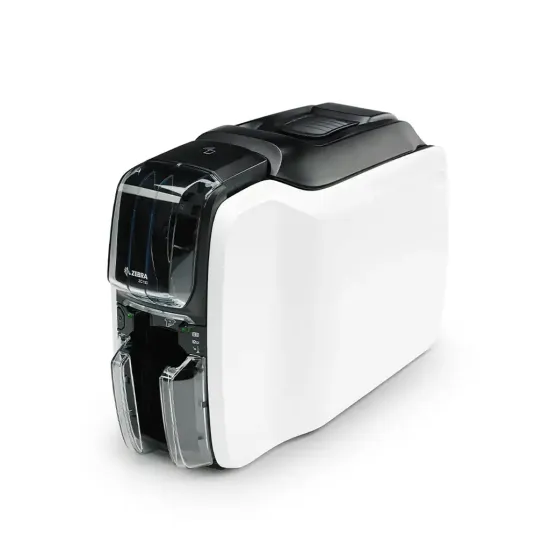
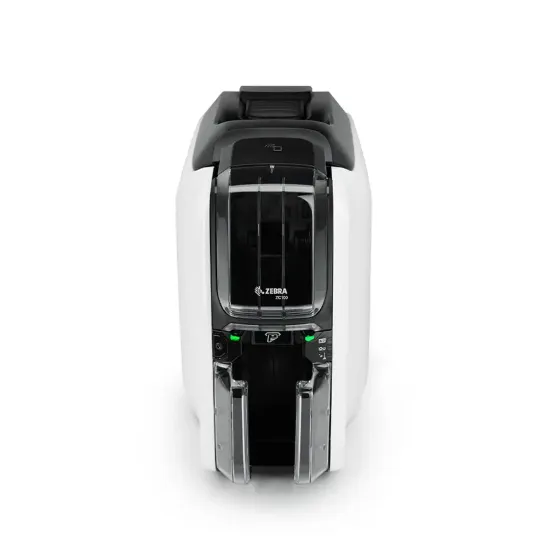
The Zebra ZC100 is a compact, single-sided direct-to-card printer built for organisations that need a reliable, easy-to-use ID card solution without complexity. It suits teams printing up to around 10,000 cards a year, covering staff badges, visitor passes, membership cards and event credentials.
Specifications
Specification
Detail
Print technology
Dye-sublimation / resin thermal transfer, direct to card
Resolution
300 dpi (11.8 dots/mm)
Print capability
Single-sided, edge-to-edge on CR-80
Colour print speed
150 cards/hr (YMCKO)
Monochrome print speed
700 cards/hr
Input hopper
100 cards (30 mil auto-adjusting)
Output hopper
100 cards (30 mil)
Manual card feed
Yes, with LED bezel guide
Card sizes
CR80, CR79
Card thickness
10 to 40 mil
Card materials
PVC and PVC composite
Memory
2 GB flash
Connectivity (standard)
USB 2.0
Connectivity (optional)
10/100 Ethernet; 802.11ac Wi-Fi
Encoding (optional)
Magnetic stripe, ISO 7811, tracks 1, 2 & 3, hi/lo coercivity (field-upgradeable)
Security
Kensington lock slot, printer host authentication, AES data encryption
Dimensions
258 mm H × 157 mm W × 383 mm D
Weight
3.9 kg
OS compatibility
Windows 7, 8, 10 and 11; Server 2008 to 2016; Ubuntu 16.x (64-bit); macOS 10.13.x
Warranty
3-year on printer and printhead
What's Included:
Zebra ZC100 ID Card Printer
Main Power Cable
Power Supply
USB Cable
Print Quality and Speed for a Working Card Programme
At 300 dpi, the ZC100 produces photo-quality colour ID cards with accurate flesh tones, sharp text and scannable barcodes. Colour cards print at 150 per hour, so a busy reception desk or HR team can keep up with demand without waiting around. Monochrome output reaches 700 cards per hour.
Full-colour printing uses a YMCKO ribbon for photo ID badges and branded cards. The five panels cover yellow, magenta, cyan, black and a protective overlay. Monochrome printing covers text-only passes, access cards and anything where colour isn't needed, at a much faster rate. The ZC100 prints edge to edge on standard CR-80 stock, so your design runs to the card border with no white margin.
The 100-card input and output hoppers mean you can run a batch and step away. If you need to print a single card outside of a batch, the manual feed slot handles it directly. An LED bezel guides the card in, so the process is straightforward even for staff who aren't regular users.
Connectivity, Encoding and Fit-Everywhere Design
The ZC100 is slim enough to sit on a reception desk or in a shared office without dominating the workspace, and its clean lines make it presentable in customer-facing areas.
USB 2.0 is standard, with Ethernet as an optional upgrade. It connects the printer to your network so you can manage card printing from a separate workstation. Wi-Fi is also available as an option. If a cable run isn't practical, Wi-Fi gives you flexible placement without committing to a fixed position. Both can be added at the point of order or in the field.
Magnetic stripe encoding is an optional upgrade, also field-upgradeable. It writes to tracks 1, 2 and 3 at high or low coercivity, to ISO 7811 standard. Access control cards, time-and-attendance credentials and loyalty cards that work with existing swipe readers are all straightforward to produce.
The ZC100 is designed to work only with genuine Zebra ribbon cartridges. The cartridges are smart-chipped, so the printer recognises the ribbon type and tracks remaining panels automatically. The cartridge only fits one way and no tools are needed, so ribbon changes take seconds.
Security, Warranty and Ongoing Supplies
The ZC100 includes a Kensington lock slot and printer host authentication with AES data encryption, protecting cardholder data during printing. If the printer is in a shared or public-facing space, a printer cover lock is available as an option to prevent unauthorised access to card stock and ribbons when the desk is unattended.
Zebra backs the ZC100 with a three-year warranty on both the printer and the printhead. That cover includes the component most likely to need attention in a working card programme.
Ribbons are the consumable you'll reorder most often. The ZC100 takes YMCKO cartridges (200 prints per roll), half-panel YMCKO (400 prints) and monochrome black (up to 2,000 prints per roll). Castlemount stocks Zebra printer ribbons compatible with the ZC100. See the Zebra Printer Ribbons category for current options.
Blank cards are the other regular consumable. The ZC100 takes standard CR80 PVC and PVC composite cards at 10 to 40 mil thickness. Castlemount's FOTODEK ID Cards range includes premium blank white cards at 760 micron (30 mil). That is the standard thickness for ID card printing and suits the photo-quality results the ZC100 produces.
Cleaning kits keep the printhead and feed rollers performing consistently. Castlemount stocks Zebra Cleaning Kits designed for the ZC100.
Who the Zebra ZC100 Was Designed for
The ZC100 is the right choice for organisations that print single-sided ID cards in-house at low to moderate volumes and need a compact, secure printer that is straightforward to run.
HR and operations teams: Printing staff ID badges and access cards for employees and contractors on site.
Reception and front-of-house: Issuing visitor passes and temporary credentials quickly, without specialist training.
Schools and colleges: Producing student and staff ID cards in a shared admin or reception environment.
Membership and leisure organisations: Printing membership cards and event credentials on demand.
Small and medium businesses: Running an in-house card programme without dedicated IT support, where simplicity and reliability matter most.
We use cookies and other tracking technologies to improve your browsing experience our website, to personalise content and ads, provide social features media and our traffic analysis.
Necessary cookies enable core functionality of the website. Without these cookies the website can not function properly.
Statistic cookies help website owners to understand how visitors interact with websites by collecting and reporting information anonymously.
A set of cookies to collect information and report about website usage statistics without personally identifying individual visitors to Google.
Marketing cookies store user data and behaviour information, which allows advertising services to target more audience groups.